Showing posts with label Burgundy. Show all posts

Wednesday, 15 August 2012

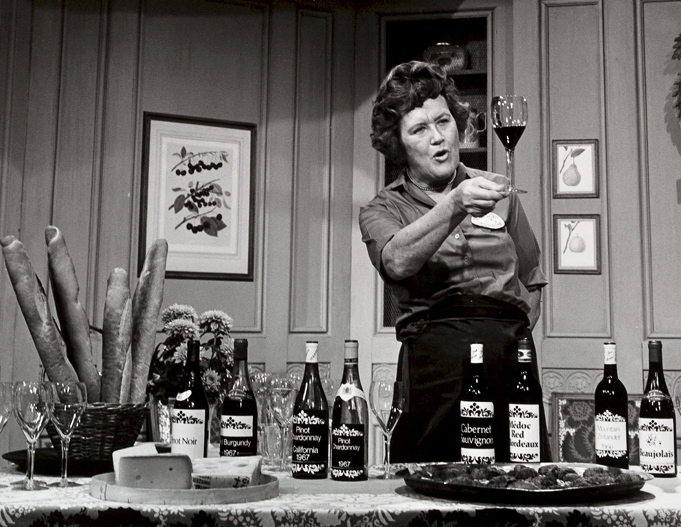
Julia Child loved fine wine as much as food


Clearly a woman of impeccable taste, American TV chef and author Julia Child was as passionate about fine wine as she was good food, and had a weakness for Château d’Yquem, Chablis, Chambertin and classed growth Bordeaux, db.com has revealed.

Speaking to The Oregonian on the eve of what would have been Child’s centenary on 15 August, close friend and travel companion Pat Pratt said: “Julia had a weakness for Château d'Yquem, especially when served with Grand Marnier soufflé or crème brulée, but she also paired it with foie gras or pâté.”

“We went to visit the château in Bordeaux and were leaning over the well in the center of the courtyard. We both lost our sunglasses down that well,” she added. Child also had a penchant for white Burgundy, and is quoted as saying: "I would happily die with a bottle of white Burgundy in my mouth.” She had a particular fondness for the minerality of Chablis, which she’d pair with lobster and oysters.

A lifelong wine lover, Child is best known for her 1961 debut cookbook, Mastering the Art of French Cooking, which features a chapter on wine. Her husband, Paul, was a wine educator who kept well-stocked cellar. Keen to enhance her wine knowledge and improve her tasting skills, Child was a member of Burgundian wine society La Confrérie des Chevaliers du Tastevin.

She indulged her passion for wine by visiting vineyards in Bordeaux, Burgundy, Italy, Alsace and California. "At every vineyard we visited, Julia and I would always taste one grape from the end of the row. We weren't supposed to, but we did," Pratt told The Oregonian. "When we had really good meals together, I would ask for the label off the bottle,” she added.  

A big Bordeaux lover, Child showed a preference for Château Palmer, Château Lafite and St Emilion Grand Cru Classé Ausone, which she once visited. Despite a love of wine, Child was strict about not indulging while at work – the glasses she raised at the end of her TV shows were filled with coloured water. For her 40th birthday, Child enjoyed roast duck and 1926 Gevrey-Chambertin, and lusted after Domaine de la Romanée-Conti, which she only got to drink once.

In Mastering the Art of French Cooking, Child recommends Château La Mission Haut-Brion with veal, Corton-Charlemagne with beef, Volnay with brie and Grands-Echézeaux with veal kidneys. A number of events organised by Les Dames d'Escoffier, an international society of professional women in the fields of food, wine and hospitality, are taking place across the US today to honour Child’s centenary.

Friday, 3 August 2012

Ridgeview

During a recent wine road trip, the gregarious Jimmy Smith, aka The Wine Guy, and I stopped off at Ridgeview in East Sussex on the day of the Olympics opening ceremony, to quaff a few of England's finest sparklers, two of which are featured in this video – Ridgeview's flagship fizz Bloomsbury Brut and quirky sparkling red Pimlico. Chin chin!

Thursday, 14 June 2012

Ponsot: “Rudy Kurniawan had an accomplice”


The plot thickens... Laurent Ponsot of Domaine Ponsot in Burgundy has spoken out about the Rudy Kurniawan wine fraud case, claiming he knows the identity of an accomplice in the the Indonesian collector’s alleged crimes – as reported earlier this week on thedrinksbusiness.com. “Rudy has been advised by someone with extensive knowledge of Burgundy. I know who it is, but in the current state of the investigation, I keep this information secret,” Ponsot told Vanity Fair. “Rudy himself should denounce his informants and his accomplices.” Ponsot added. 
One possible accomplice is Kurniawan’s Burgundy-born friend and former business associate Paul Wasserman, who met Kurniawan in 2002. Managing a wine shop Kurniawan bought in LA, Wasserman educated the young collector in the intricacies of Burgundy. “He would call me regularly for buying advice and insights into producers, vineyards and vintages. He was avid for information and I was an excellent source for him,” Wasserman told Vanity Fair
Defending himself on wine writer Mike Steinberger’s Wine Diarist website, Wasserman denied any knowledge of Kurniawan’s counterfeiting activities and apologised for “any unwitting role” that may have contributed to the scandal. Wasserman claims he and the now 35-year-old Kurniawan fell out at the end of 2008. Having been indicted by a federal jury in New York on 9 May, details emerged about Kurniawan’s counterfeiting methods. 
Known for asking for the empty bottles of the old and rare wines he drank at Cru restaurant in New York, Kurniawan had been refilling the bottles with blends he made from lesser wines, including large quantities of négociant Burgundy from the ‘50s and ‘60s, many of which were bought from Beaune-based merchant Patriache. “Rudy emptied the cellar of Patricache,” a French merchant told VF, adding, “He had a certain respect for the product; you might say he was a gentleman thief.” Ponsot believes 80% of pre-1980 Burgundy being sold at auction today is fake.
According to Mike Steinberger, author of the Vanity Fair article, Kurniawan’s arrest raises uncomfortable questions for John Kapon, head of auction house Acker Merral & Condit. “Kurniawan played a central role in Acker Merral’s rise, and much of the discussion among industry insiders has focused on Kapon’s part in the scandal,” Steinberger wrote. In April 2008, 97 bottles of Domaine Ponsot belonging to Kurniawan were withdrawn at the last minute by Kapon from an Acker auction at Cru in New York.
Among the lots was a bottle of 1929 Ponsot Clos de la Roche, a grand cru the domaine didn’t produce under its own label until 1934, and 38 bottles of Ponsot Clos Saint-Denis from 1945 to 1971, despite the estate not making the wine until 1982. Ponsot had flown in from France especially for the auction, believing he needed needed to be in the room in order to prevent their sale. 
The 58-year-old proprietor admitted to Steinberger that he felt “a bit of glory” at the fact that Kurniawan deemed his wines worthy of counterfeiting. “You don’t copy Swatch. You copy Breitling and Rolex,” he said, though conceded that the fraud felt like “an attack on the terroir and spirit of Burgundy.” Kurniawan faces up to 80 years in prison. He pleaded not guilty at his arraignment on 23 May. 

Friday, 13 April 2012

Seely seeking second Burgundy property

Christian Seely, managing director of AXA Millésimes – owners of Château Pichon Baron and Domaine de l’Arlot – has revealed he is on the hunt for a second Burgundy property. “I’m acutely looking to add a second Burgundy estate to our portfolio, but it’s very difficult,” he told the drinks business at the Pichon Baron 2011 primeurs tasting last week. Seely also admitted that he is looking to buy in the New World, but wouldn’t elaborate on where.

With regards to the 2011 vintage, he said the majority of people who tasted at Pichon Baron were “pleasantly surprised” by the quality of the vintage. “There hasn’t been the euphoria of 2009 and 2010, but people seem pleasantly surprised by the quality of Pichon 2011, perhaps because expectations weren’t very high. Not all 2011s are good, but those who picked well made lovely wines,” he said.

Seely also revealed that he is using increasing amounts of Semillon in his dry white, S de Suduiraut, from Sauternes estate Château Suduiraut. “My big aim is to make a dry white from the Sauternes region that tastes like Sauternes. We predominantly use Semillon in our sweet Sauternes, so it makes sense to use it in “S” too. We’ve made a few experimental bottles of 100% Semillon and it’s utterly delicious, so I know I’m on the right track,” he said.

“The fear is that with a majority of Semillon in the blend it won’t age well, but I know that it will. Unfortunately, it will be hard to increase production to supply demand as the only way to make it well is to use grapes destined for Suduiraut,” he added. Comparing the 2011 Sauternes vintage to the acclaimed 2001, Seely described the wines as “very rich, with high levels of residual sugar and botrytis, but super fresh, with lovely complexity and depth.”

Over at Château Pontet-Canet, owner Alfred Tesseron said that being biodynamic didn’t necessarily make it harder for him during the capricious 2011 growing season. “It’s all about your approach – being biodynamic, you have to always be one step ahead and work on a prevention rather than cure basis. 2011 was a difficult vintage, but every year presents different challenges. The weather was very up and down, so we had no room for manoeuvre,” he admitted.

Tesseron revealed his main reason for going biodynamic was for the positive affect it has on the taste of Pontet-Canet. He is currently exploring the effect of egg-shaped fermenters on the maturation process. “A lot of Bordeaux wines are over-oaked and I’m looking to find the right balance. I chose the fermenters for their breathability rather than their egg shape, but it’s too early to say whether I’m pleased with the results,” he said.

Sunday, 26 February 2012

Chinese names for Bordeaux revealed

Christie’s auction house has unveiled an official translation of the 61 châteaux in the 1855 classification, after a year of discussions with the estates. As reported on thedrinksbusiness.com, all but four of the châteaux have approved the Chinese translation of their names.

“We have confirmation from all but four châteaux that these Chinese translations are the agreed names for the whole Chinese speaking world,” said Simon Tam (above), Christie’s head of wine in China. “We are trying to make wine as accessible as possible for our clients. Language is the first barrier and we want to break down those barriers,” he added.

The auction house worked with châteaux to agree on a Chinese translation for the 61 estates. Though a small number of châteaux, including Cos d’Estournel, have decided not to take a Chinese name. The translations have been published on a poster (right), which will be unveiled to the trade during the 2012 en primeur week.

The posters will also be given to Christie’s clients and journalists. Tam is hoping that other auction houses and the wider wine trade will adopt the official translation. Christie’s is working on similar translations for properties in Sauternes, the right bank of Bordeaux and Burgundy, which it hopes to release later this year.

Wednesday, 22 February 2012

Dan Aykroyd on wine

In the second part of my interview with Ghostbusters star Dan Aykroyd, he tells me about his wine epiphany while filming The Blues Brothers, opening a treasured bottle of Trotanoy given to him by River Phoenix, and why Canadian ice wine would feature in his death row meal.

Friday, 17 February 2012

RAW artisan wine fair comes to London

An artisan wine fair for fine, organic and biodynamic wines dubbed “RAW”, will launch in London this May. As reported on thedrinksbusiness.com, the event will take place at the Old Truman Brewery in East London on 20-21 May, and will feature over 150 growers. Classic regions such as Burgundy, Bordeaux and Piedmont will be represented, as well as newcomers like Georgia and Serbia.

Organised by Isabelle Legeron MW (above), co-founder of last year’s Natural Wine Fair at Borough Market in London Bridge, RAW aims to build on the success of the Natural Wine Fair by acting as an independent event open to all producers, importers and official bodies. International grower associations La Renaissance des Appellations and VinNatur will be taking part, bringing with them growers from across the globe.

“My aim is to promote transparency in the wine world in order to support the art of authentic wine production. I want to help people think about what they drink’,” said Legeron. RAW is enforcing a charter of quality that all exhibitors must adhere to – in order for a wine to be on show at the fair, all grapes must have been farmed organically or biodynamically, only indigenous yeasts used and the sulphur levels must be clearly labelled on the bottle.

The fair will include talks from a number of wine expects, including biodynamic ambassador Nicolas Joly of La Coulée de Serrant in Savennières, and José Vouillamoz, co-author of Jancis Robinson MW's forthcoming book The Grape. There will also be a pop-up wine shop.

Monday, 30 January 2012

Sir Terence Conran: My Passion for Wine


Wine and the City spends an afternoon with the indefatigable author, designer and restaurateur behind the Habitat furniture chain and London restaurants Bluebird and Boundary, to chat about drinking Cahors with Nancy Cunard in the '50s, smoking Cuban cigars with David Hockney, and a road trip to Burgundy in Bill Baker's Land Rover.

When did your interest in wine begin?

I got into wine while working as a designer for John Harvey & Sons in Bristol – a breeding ground for some of the most influential people in the wine trade: Michael Broadbent, Harry Waugh – you name it. It was the most wonderful induction to the world of fine wine.

How did you develop your newfound passion?

I started drinking quality wine and began to understand the differences between vintages, châteaux and regions. I decided red and white Burgundy were my passions – they have an indefinable decadence about them. I was born in 1931, which was a terrible year for Bordeaux. As a result I’ve been given some disastrous presents. Michael Broadbent gave me a bottle of 1931 Haut-Brion, which was undrinkable vinegar. Luckily, it was a good year for Port.

Are you a Bordeaux or a Burgundy man?

As I get older, I understand the subtlety of wine more. I find Burgundy more French than Bordeaux. Bordeaux has been Americanised and is very concerned with money. Burgundy is more intellectual than Bordeaux. Old Burgundy has such fantastic, complex flavours. I’ve got two cellars under my house in Berkshire, one for white wine and one for red. They’re the perfect temperature and humidity for both wine and cigars.

I’ve heard you’re partial to the odd cigar…

Cigars are another passion – I smoke three Hoyo de Monterrey Epicure No2s a day. I often drink Chilean wine as I find it robust, full of flavour and well priced. I object to paying £500 for a bottle of wine. Being a war child I am still obsessed with value for money. I’ve tried Pétrus on very few occasions. It’s a beautiful wine, but I can’t drink it in a relaxed way.

Who do you like to share your prized bottles with?

My dear friend Bill Baker, who died three years ago, was the best person to drink wine with. I shared a huge number of bottles with him over the years, and bought most of my wine from him at Reid Wines – he was incredibly knowledgeable. He would drive me around Burgundy in his huge Land Rover, loading case after case at every vineyard we stopped off at. When I went on Eurostar with him, he’d bring a big basket full of wine, which we’d crack open during the journey.

Do you see wine as an investment or something to enjoy?

Both. I’m not an investor in wine, but I like the idea of it. If you’re going to invest in anything, then wine and art are the best things to spend your money on because you can enjoy your investment. I collect a lot of art. I buy my contemporaries – Hodgkin and Hockney. Hockney is a big wine lover – I’ve drunk vast quantities of wine and smoked many cigars with him. On a trip to Southern France in the early ’50s I went to stay in a converted barn belonging to English socialite and heiress Nancy Cunard (pictured), who counted Aldous Huxley and TS Eliot among her lovers. We drank Cahors late into the night until our teeth went black.

Article originally published in Decanter magazine

Thursday, 12 January 2012

Domaine Dujac

Wine and the City talks to Alec Seysses of Domaine Dujac at the Berry Bros Burgundy 2010 en primeur tasting about the 2010 vintage, comparisons to 2009, how lower yields will affect pricing, and whether Burgundy will become the next big wine investment region for China.

Tuesday, 23 August 2011

Wines of Rapture at Quo Vadis

Supine on a striped sofa in the appropriately titled “Petting Room” of Quo Vadis in Soho, I’m surrounded by leather, lingerie and literature. Resplendent in his signature Burgundy suit and immaculately clipped beard, the dashing, debonair and dangerous Wine Chap, formally known as Tom Harrow, is holding court, explaining to his captive audience that smell is the most powerful, underrated and sensuous of the senses. “We’re drawn to potential mates by their smell – Napoleon went wild for the smell of Josephine’s unwashed body,” he asserts, “and I have it on good authority that I smell great. A dab of Grappa behind each ear and I’m good to go.” Exuding an almost Neanderthal sexual energy, Harrow cuts a swaggering figure in the room. His sidekick, Cecelia, a full-lipped Swede in a raspberry beret and scarlet velvet plus fours, is here to showcase her wares from erotic emporium Bordello, affectionately known as the “nipple of Shoreditch.”

The small square room is accessorised with candy stripe carpets, regal red curtains, art strewn walls and a bookshelf heaving with oddities. The low-slung wooden table in front of me is well seasoned with erotic paraphernalia, from a leather whip fastened with a pair of fur balls that look like they’ve been pilfered from a well-endowed squirrel, to a pastel pink copy of A Compendium of Kisses – an insightful guide to the art of locking lips.

A sprinkling of kinky couples and curious singletons populate the room. Raven haired proprietor Sam Hart perches impishly on the window ledge in the far corner as if hoping to dissolve into the surroundings. We are gathered for Harrow’s Wines of Rapture event, billed as “an inner striptease” celebrating the divine union of Bacchus and Venus. Urging us to use wine – faithful friend of poets and lovers, as a seduction tool, the tasting begins in the land of love (Italy) with Dal Bello Rocca d’Asolo Prosecco, its tongue tingling effervescence compared to the breath of a lover caressing your neck. Light, elegant and delicate, it’s the romantic equivalent of a peck on the cheek.

Foreplay begins in earnest with an unctuous white Burgundy – Domaine Emilian Gillet Vire-Clesse Quintaine 2007, representing, according to Harrow, a “thickening of the juices”. Rich, waxy, honeyed and seductive, there are few things less sublime than the first sip of a creamy white Burgundy. Having lost its primary fruit, brioche and cooked apple notes have made their way to the fore in the liquid embodiment of a lingering kiss. Glancing round the room, I sense the impending urgency of the situation. Lascivious looks are being exchanged and metaphorical clothes are flying off in all directions.

Moving on to the meat of the matter, we tackle Meerlust’s lusty Rubicon 2005, named after Julius Cesar’s historical crossing of the Italian river in 49 BC, and neatly symbolising the point of no return. Weighing in at a hefty 14%, the savage red, full of deep, dark fruit is brooding and sexy; it’s a full-throated roar of a wine, or, as Tom so elegantly puts it, “a man ripping his clothes off and leaping onto his maiden.” Now well oiled, the once timid crowd is engaged in animated banter. The chap opposite me picks up a wooden paddle and spanks his paramour with it, while the couple beside me, who are celebrating their 10th anniversary, appear to be seriously considering the squirrel whip.

Divine intervention follows in the form of Domaine Giraud Châteauneuf-du-Pape; the preferred wine of Pope Clement V. With a nose of lit match, meat, polished leather and musty church pews, it reeks of ecclesiastical vice. “If Bordeaux is your wife and Burgundy your mistress, then Châteauneuf-du-Pape is your dirty weekend,” Harrow quips. Virulently alcoholic and imbued with sweet fruit, the rugged red, with its masculine thrust, smacks of Oliver Mellors from Lady Chatterley’s Lover.

Visibly hot under the collar, and delighting in the debauchery, Harrow launches into an anecdote about the irreverent Italian nobleman Cesare Borgia, who one night swapped partners with his mistress’s 15-year-old daughter mid-stroke. He goes on to explain how a lady’s favourite wine determines how she will be in the bedroom, citing from personal experience that Pinot Grigio girls are pedestrian and predictable, while Barolo quaffers are sexual deviants.

We move swiftly on to the climax – La Giaretta Amarone 2007. Seductively speaking, we’re in the final throws of passion. At 15.5%, this is a beast of a wine. Hedonistic, powerful and concentrated, the lusty liquid brings us to the tipping point, where we dissolve into the mystic bliss of what the French so quaintly call “le petite mort”. At the moment of sweet release, having expended our life force, we transcend the terrestrial and connect with the divine, as our ecstasy takes on a spiritual purity. Post-explosion, we luxuriate in the glorious afterglow with liquid gold provided by delicate dessert wine Château Laurette Saint Croix du Mont 2006. Like the sweet fruit of the gods, the unctuous golden elixir is laced with honeysuckle and almond. This is the cigarette moment – the end of the affair. I’m spent.

For more information about upcoming WineChap events, visit the website

Monday, 17 January 2011

Video: Olivier Leriche, Domaine de L'Arlot

Wine and the City catches up with Olivier Leriche, owner and winemaker of Domaine de L'Arlot in Nuits-Saint-Georges, at the Corney & Barrow Burgundy 2009 En Primeur tasting at the Tower of London to talk biodynamics, characteristics of the ’09 vintage, and a growing interest from the Asian market.