Showing posts with label The Ledbury. Show all posts

Tuesday, 8 January 2013

Top 10 restaurants of 2012


As we bid farewell to 2012 and usher in 2013, it seems like an apt time to revisit my top 10 meals of last year. It was a spectacular year for food that saw the rise of gourmet junk food through joints like Bubbledogs in Fitzrovia and Wishbone in Brixton. Meanwhile, our obsession with burgers led to two new Burger & Lobster sites and the openings of MeatMarket in Covent Garden, Honest Burgers in Soho and Dirty Burger in Highgate, proving the trend is showing no sign of slowing. Londoners also got ravenous for ramen, with Bone Daddies and Tonkotsu in Soho leading the noodle charge. Finally, Nuno Mendes of Viajante's prediction that Peruvian cuisine would make waves in the capital came true in the form of dynamic duo Lima London and Ceviche, with Pisco Sours and mouth-puckering ceviche taking centre stage.

Rather than focusing on new openings, I've rounded up my top 10 meals of 2012. While the majority are in London, two were enjoyed in Champagne and one in Modena in northern Italy. Each earned their place on the list by offering an all-round experience, from the setting and the ambiance to the food, wine and company. While exemplary cooking can be enjoyed in isolation, it is the unique dining experiences of my top 10 that sets them apart. 

10: Davíd Muñoz at Ibérica Canary Wharf

Mohawk-sporting Spanish chef Davíd Muñoz set London alight for one night only at Ibérica Canary Wharf in October, when the restaurant was closed to showcase the experimental food from the young chef''s 2 Michelin-starred restaurant DiverXO in Madrid to a cherry picked group of food writers. From amuse bouche to petit fours, Muñoz's adventurous menu was filled with outrageous flavour combinations, the majority of which he pulled off with aplomb, from a crispy oxtail sandwich with baby eel and japapeños (pictured), to wild boar "civet" of black cod with parsnip and liquorice. Beg, steal or blag your way to a reservation at DiverXO for a ringside seat to the Muñoz magic


9: Bob Bob Ricard

Owned by immaculately attired Russian, Leonid Shutov, Bob Bob Ricard is a restaurant for suffers of Golden Age syndrome. Ushered in by a black cloaked doorman, a night in its clutches is a transcendent experience. Bob Bob's lavish interiors evoke an Edwardian Orient Express carriage, from the plush midnight blue booths complete with pleated lampshades and velvet curtains, to the smoked Venetian mirrors and brass railings – I could dine out on the interiors alone. 

But what of the food, you cry. Portions are small and perfectly formed, from the signature three cheese soufflé  and textured venison tartare to a bath bomb-like exploding Eton mess and divine salted caramel ice cream. BBR is a one off – a flight of fancy back to an age of elegance. 

8: Salt Yard 
Salt Yard makes up a third of Simon Mullins and Sanja Morris’ Spanish restaurant empire, with Dehesa in Oxford Circus and Opera Tavern in Covent Garden completing the trio. On my visit one drizzly Sunday lunchtime, head chef Andrew Clark – a towering figure with a sailor’s beard, heavily inked arms and a smile that stretches to Gibraltar, whipped up an eight-course menu highlighting Andalusia’s rich culinary history, including numerous hat tips to the Moors.
Highlights of the feast included lip-smackingly fresh sea bream ceviche with a scoop of gazpacho sorbet hovering atop the dish like a frozen egg yolk, and soft shell crab with saffron aioli that danced on its black slate atop squid rings, spindly legs splayed. Perhaps the most Moorish of the octet was chargrilled quail with molasses and pomegranate seeds that glinted like rubies. Like Davíd Muñoz, energetic young Clark is one to watch on the Spanish food circuit.

7: Madame Bollinger's house 
In March, I was lucky enough to be invited to Bollinger to take part in the Champagne house's annual vin clairs tasting. During the visit, a small group of us dined at Madame Bollinger's house, which has been kept the same since her death in 1977, from the wild boar heads on the walls (the forests in Champagne are full of them), to her mint green dining room. The food was exquisitely presented and packed with flavour, from red mullet in a creamy sauce to a tart  raspberry mille feuille, all expertly matched to different wines in the Bollinger range, proving that Champagne can be enjoyed throughout a meal. 
The highlight chez Lily Bollinger were two chunks of vintage Comté from cheese maestro Bernard Anthony, France's Comté king. Rich, grainy, creamy and nutty, it proved a sensational match for Bollinger R.D. 1996, the cheese echoing the intense, nutty power of the wine in perhaps the most inspired food and wine match of the year.

6: Viajante

Two of my top 10 meals of 2012 took place on the same day. Dinner at Viajante, Portuguese-born Nuno Mendes’ Michelin-starred restaurant at the Town Hall Hotel in Bethnal Green, is an edible journey taking in a kaleidoscope of colours, textures, temperatures and flavours from the safety of your pale blue chair. The softly spoken, raven haired, generously inked, contagiously passionate Mendes has been christened the Heston of Hoxton due to his fondness for molecular techniques.
Hightlights of this 14-course feast (if you count the amuse bouches) were plentiful, but those that stand out most vividly in the mind include a salty and scandalously moreish godal olive soup served as chilled as a Bond Martini – a triumph of style and substance. Potato with yeast meanwhile, attacked the taste buds with razor-thin fatty folds of intensely porcine Ibérico pancetta wrapped gossamer-like around a small potato, while squid with pear caramel and swooshes of squid ink was reminiscent of both Japanese calligraphy and Spanish Surrealist painter Joan Miró. 

To cap off an unforgettable experience, an ice-cold chunk of vanilla and extra virgin olive oil the size of a toffee was presented to me by the magician himself on a white stone. Told to eat it straight away, despite its sub-zero temperature, in the mouth it rewards with an unctuous texture and rich, creamy flavour perfectly marrying sweet and savoury. I can't wait to see what Mendes does next. 

5: Hibiscus
While he may have caused a storm in a saucepan late last year for laying into food blogger James Isherwood for deigning to criticise his food and giving him a 3 out of 5 rating, there is no denying that tempestuous and exuberant French chef Claude Bosi has talent. The only thing that lets his Mayfair restaurant Hibiscus down is its airport lounge decor - a sea of beige and wood panelling, but this is soon to change as the restaurant is currently closed for a makeover.

Bosi's dishes are daring and unapologetic, from yuzu and miso croquettes so addictive, I'm suspicious they might have been laced with crack, to mackerel tartare with a layer of button mushroom cream prettified with edible flowers amid shards of almond sticking out of the top like shark teeth. When eaten together, the result is a rich, creamy and perfumed mouthful given texture by the almond shards. A pleated ravioli stuffed with spring onion and aromatic Kaffir lime served with a buttery, broad bean and mint purée proved equally intriguing.

4: The Ledbury

In December I spent a heavenly night at two Michelin-starred restaurant The Ledbury in Notting Hill, run by indefatigable Australian cheff Brett Graham, at a Krug dinner hosted by Olivier Krug and Bordeaux Index. Unoriginal as I might be, I can't praise The Ledbury enough. There is something magical about it. When I walked through the door, the affable manager remembered my name - it's little touches like this that turn great restaurants into outstanding ones.  
And so to the food. As it was a Champagne dinner, a lot of thought had gone into the food and wine matches, from a citric roast scallop dish with pumpkin, clementine and ginger, which matched incredibly well with multi-vintage blend Krug Grand Cuvée, to a meaty hunk of native lobster in a nutty Amontillado sauce and an unapologetically decadent chicken breast with Parmesan and generous shavings of white truffle, which paired perfectly with a glass of dessicated coconut and lemon sherbet-fuelled Krug 1998. It will be interesting to see where The Ledbury lands in this year's World's 50 Best Restaurant list.

3: Les Crayères
In November I was sent into orbit courtesy of Dom Pérignon and its ebullient cellar master, Richard Geoffroy, who invited a select group of wine writers to sprawling 19th century, 5 star château hotel Les Crayeres in Champagne for the night to test the effect of temperature on the flavour profile of DP at the hotel's 2 Michelin-starred restaurant, a magnificent, chandelier-filled room boasting verdant tapestries, swagged curtains and a grand dining table cutting through it.

Over the course of two hours, eight different dishes, from bracing saline oysters in a seawater granita, and a creamy mussel soup, to tea smoked basmati rice with mushroom tobacco, and an almond-flecked lamb tagine, were served to compliment the aroma and flavour differences in Dom Pérignon Oenothèque 1996 at eight different temperature stages, starting at 8 degrees and ending at 15/16º

Fascinatingly, there were tangible differences in the wine at each of the eight stages, moving from mineral at 8º, honeyed at 9º, zesty at 10º, buttery at 11º, earthy at 12º, truffly at 13º, smoky at 14º, and nutty at 15-16º. To Geoffroy's delight, I offered that the wine's evolution could be compared to the different stages of seduction, as it moved from being shy and tight to gloriously expressive.

2: A Taste of Noma at Claridge's 
A close contender for the top spot, Rene Redzepi's 10-day stint at Claridge's last summer was met with much fanfare. Under pressure to create a headline-grabbing dish to keep his fans happy and silence his critics, Redzepi didn't disappoint. On arrival, guests were offered a kilner jar filled with cabbage, which, when popped open, revealed an army of ants crawling across the lime green leaves, the odd ant or two getting stuck in globules of creme fraiche. Having mustered the gumption to put one of the critters in my mouth, I'm rewarded with a pleasing taste of lemongrass, as they share a chemical compound.

Meanwhile, a plant pot filled with edible flowers, carrots and radishes indulges the inner child. Told to use our hands, I feel like Peter Rabbit running riot in Mr. McGregor’s garden as I delve into the pot and unearth chunks of edible soil made from hazelnuts, rye, malt, beer and butter. Slow roast celeriac in a dense truffle sauce as black as squid ink, is one of the most delicious things I've ever put in my mouth. The ensemble is comfortingly autumnal, like shoving your nose deep into the forest floor and breathing in a lungful of earthy air. 

The main event: Romney Marsh neck of lamb marinated for 24 hours in pea miso, then cooked for a further 24 – is achingly tender, falling apart at the sight of a knife, and unashamedly rich in flavour, the sweet, fatty meat served with cooling milk curd and crunchy vegetables smoked Noma-style on Claridge’s roof. Technically immaculate, charmingly playful and exquisitely presented, while a trip to Noma remains a distant dream, my taste of Noma lingers sweeetly in the mind.

1: Osteria Francescana
There could only ever be one winner. My number one meal of 2012 was a bizarre and beautiuful expeirence I'll never forget. During a press trip to Modena, I was taken down the rabbit hole at the 3 Michelin-starred Osteria Francescana, voted the fifth best restaurant in the world at this year’s World’s 50 Best Restaurants awards. Headed up by the excitable, bespectacled, ever-playful Massimo Bottura, the 11-table, 28-seater restaurant is so tiny, it feels like you’re in Bottura’s front room, having been invited to a surreal dinner party. Though Bottura’s dishes are inspired and informed by Italian produce, with Emilia-Romagna his faithful muse, they’re light years away from the rusticity of an osteria.

Highlights of the magical meal were plentiful, from a gleaming fillet of Po River eel and a hunk of swan-white Alaska black cod with a soot black roof fashioned from vegetable ash swimming in a pool of squid ink broth so opaque it looked like glittering crude oil, to signature dish Five Ages, Textures and Temperatures of Parmigiano Reggiano, an ethereal composition of Parmesan sauce, mousse, foam, crisp and air aged between 18 and 50 months and served at varying temperatures, from stone cold to womb warm. 

Meanwhile, fleshy folds of  soft, supple and sweet five-year-old Culatello ham paired with an amber bottle of 1971 Château Gilette Sauternes fragrant with almond, quince and apricot was divine. Ever the sourcerer, Bottura ended the feast on a savoury note with a hazelnut-coated foie gras lollipop fashioned into a mini Feast. If only Mr Whippy vans served them...

Wednesday, 10 October 2012

The Ledbury crowned UK’s best restaurant, again...


Two Michelin-starred Notting Hill restaurant The Ledbury has been crowned the best restaurant in the UK at the National Restaurant Awards for the third year running. As reported on db.com, the restaurant, run by Australian chef Brett Graham, saw off competition from Jason Atherton’s Pollen Street Social and Marlow pub The Hand and Flowers, which came in second and third respectively.

Owned and run by Tom Kerridge, The Hand and Flowers, the world’s first pub to be awarded two Michelin stars, was also named Gastropub of the Year. Five of the top ten restaurants on this year’s list are in London, with Quo Vadis in Soho, run by Jeremy Lee, the highest new entry at number 9. Master sommelier Xavier Rousset’s Texture in Marylebone bagged the Wine List of the Year award, while Lima London in Fitzrovia was voted the One to Watch.

Phil Howard meanwhile, of two Michelin-starred The Square in Mayfair, was voted Chef’s Chef, while Dinner by Heston Blumenthal picked up the Hotel Restaurant of the Year award. Chris Corbin and Jeremy King, owners of celebrity favourites The Wolseley and The Delaunay, along with the newly opened Brasserie Zedel, scooped the Personality of the Year award.

Earlier this year, the Ledbury climbed 20 places to number 14 at The World’s 50 Best Restaurant Awards, making it the highest climber on the list. And if running the UK’s best restaurant wasn’t enough, Graham and his team heroically protected diners last August when the restaurant was attacked during the London riots, chasing away masked looters with rolling pins.

Now in their fifth year, the National Restaurant Awards aim to highlight the best restaurants in the UK and reward the nation’s top chefs and restaurateurs. The restaurants are voted for by a team of 150 chefs, restaurateurs, food critics and journalists across 12 UK regions. Chefs are not allowed to vote for their own restaurant. 

The Top 10 Restaurants in the UK

1: The Ledbury, London

2: Pollen Street Social, London

3: The Hand & Flowers, Marlow

4: Restaurant Sat Bains, Nottingham

5: The Fat Duck, Bray

6: The Sportsman, Seasalter

7: The Square, London

8: The Kitchen, Edinburgh

9: Quo Vadis, London

10: Dinner by Heston Blumenthal, London 

Friday, 2 March 2012

La Trompette

La Trompette turns 11 in April. In London’s merry-go-round of a restaurant scene, 11 years is a significant achievement, when the lifespan of many establishments is shorter than a house mouse. Located off the beaten track in Chiswick’s Devonshire Road, the cosy Michelin-starred venue is very much a neighbourhood restaurant.

One fifth of Nigel Platts-Martin’s restaurant empire, which also includes The Ledbury in Notting Hill, The Square in Mayfair, Chez Bruce in Wandsworth and The Glasshouse in Kew, from the chocolate brown leather banquettes to the beige colour scheme, everything about La Trompette is achingly tasteful. On my visit, the small space is populated with local ladies and courting couples. Lighting is low and chairs square. An old-fashioned bar remains invitingly open at the far end, prettified with white orchids.

On arrival, Lionel, our baby-faced, bespectacled French sommelier, glides over to our table and launches into an impassioned recital of the wine list, pushing us towards daring pairings. Turning down his initial offer of a Greek Assyrtiko, I opt instead for his second suggestion – a zippy 2010 Zárate Albariño from Spain’s über cool Rías Biaxas region, which sings with apricot, lime and flint. Before the main event, my dining companion and I are treated to a cappuccino-coloured cup of cep and potato soup, served with a cheeky ham and cheese croûte. As if determined to fill us up, our waitress is unnervingly forthcoming with the walnut, raisin and olive bread, and I feel compelled to try the holy trinity.

The soup doubles for central heating on this frosty night, the earthiness of the mushrooms complementing the creaminess of the potato, the ensemble lifted by a citrus element I suspect to be yuzu, leaving me craving a mixing bowl full of the elixir (wooden spoon optional). Rather than a main course, I order three starters, perhaps having got so used to the sharing plates philosophy peddled in Soho’s hip hangouts. Their signature starter of foie grass dressed with lentils is heavenly. Accompanied by a slab of brioche shaped like a Champagne cork, the foie gras arrives in a white china pot beneath a bed of toad green lentils. Rich, creamy and impossibly smooth, each mouthful is more delicious than the last, and though the lentils add texture, I would have been happy with the creamy foie alone – why play with perfection?

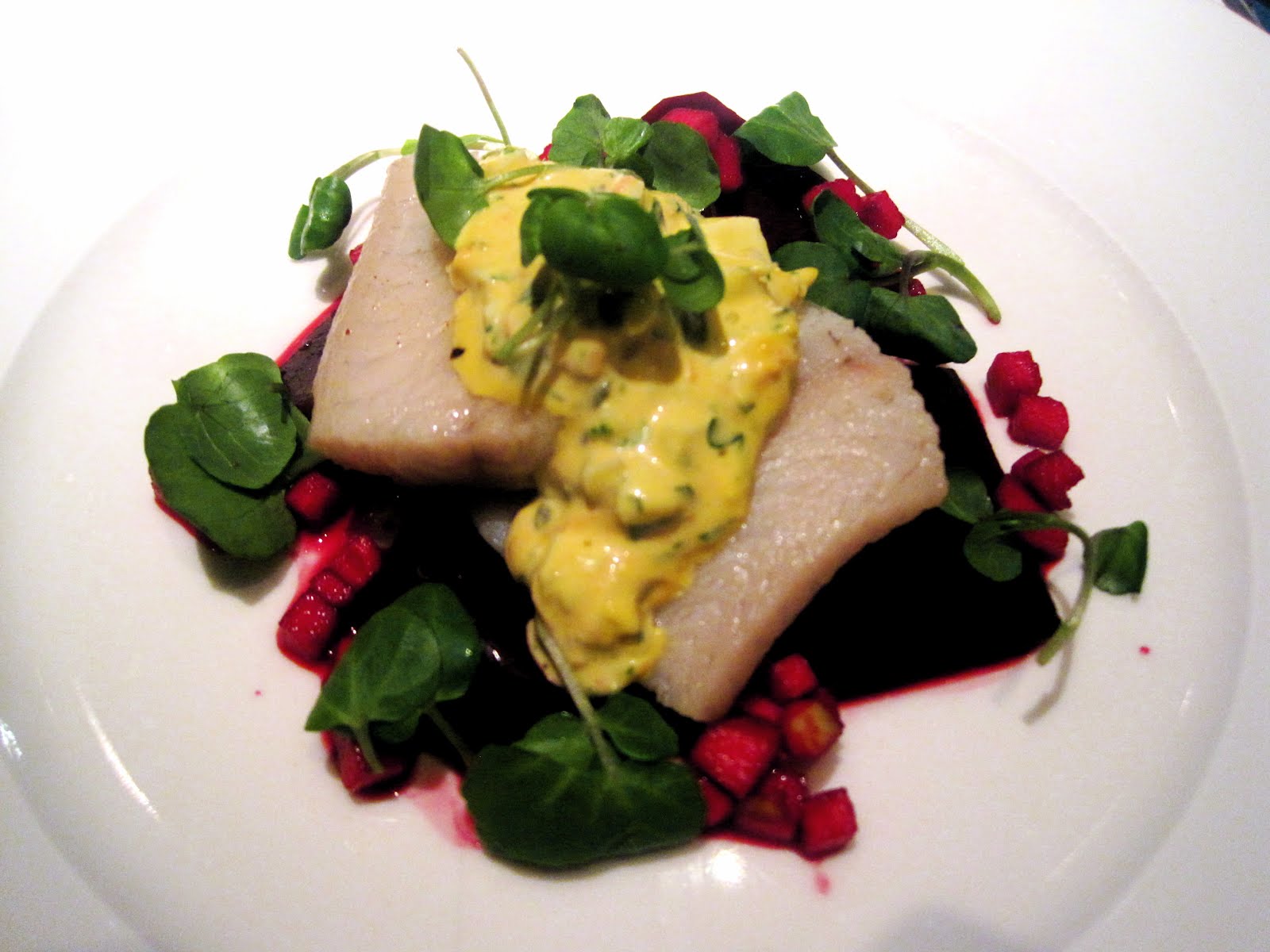
A second starter of smoked eel with balsamic beetroot and egg and wasabi mayonnaise is enchanting. The pearl pink slices of meaty eel rest atop a bed of beetroot and watercress, the smoky taste of the fish lifted by refreshing cubes of apple dyed red by the beetroot ink, while the mustard-yellow wasabi mayo delivers a life-affirming kick of heat. After a trio of standout dishes, my final starter of tagliatelle, purple sprouting broccoli, capocollo and mozarella fails to reach such heights.

Though painterly in appearance, the pink ham and grass green broccoli jumping out against the sunshine yellow pasta, the consistency of the sauce is disappointingly watery, while the melted mozzarella chunks are bland and soggy. For a Michelin-starred restaurant, the dish doesn’t have the X-factor, lacking the intrigue and finesse I’d expect. Lionel however, delights, pitting 2009 Ernst Triebaumer Blaufrankisch from Austria against 2009 Black Cottage Central Otago Pinot Noir. The former is floral, feminine and perfumed, while the latter bursts with black cherry and red berries, offering a easy going, fruity mouthful.

To enliven our palates, we’re offered a pre-dessert in the form of a tiny triangle of ginger cake, enhanced by a dollop of crème fraiche and grated lime peel. Pudding proper is a satellite dish of crème brûlée. The creamy, vanilla-flecked interior is à point, though I find myself defeated after half. To pair, Lionel presents his final flourish, a glass of 2008 Muscat de Samos Grand Cru, served so cold it needed defrosting. Had the bottle been left out in the snow?

Being a Chiswick local, I wanted to like La Trompette more than I did. I wanted to blow its trumpet. It has all the hallmarks of a superb neighbourhood restaurant – service is attentive yet unobtrusive, the atmosphere is animated, the interiors tasteful, and yet for me there was something missing. That all-important sparkle that separates a good restaurant from a great one. La Trompette displays flashes of brilliance, but it failed to keep my fire lit.

La Trompette, 5-7 Devonshire Road, Chiswick, London W4 2EU; Tel: +44 (0)20 8747 1836; £42.50 for three courses.

Tuesday, 10 January 2012

Aldo Conterno at The Ledbury

2011 was quite a year for The Ledbury. The small, neighbourhood restaurant in Notting Hill maintained its two Michelin stars, became ingratiated into the San Pellegrino World's 50 Best Restaurants as the highest newcomer at number 34, was crowned The Sunday Times UK restaurant of the year, and if all that wasn't exhausting enough, Australian head chef Brett Graham and his staff heroically protected diners when the restaurant was attacked during the London riots in August, chasing away masked looters with rolling pins.

I was lucky enough to get a slice of The Ledbury action in late November, having been invited by wine whiz kid Gareth Birchley of fine wine trader Bordeaux Index to attend an Aldo Conterno dinner hosted by Conterno's son Franco. The Conterno family is arguably Barolo's premier winemaking dynasty – Aldo's father Giacomo was one of the stalwarts of the region. But, rather than joining his brother Giovanni in the running of the family estate, Aldo struck out on his own in 1969. While Giovanni continued to make benchmark Barolo under the Giacomo Conterno label, Aldo ploughed his own furrow, making a more accessible style of Barolo than his family's traditional style.

Arriving fashionably late, the restaurant, which had been closed to the public for the event, was already buzzing with animated banter, helped along by glasses of ice-cold Pol Roger NV. Each and every canapé was a thing of beauty, from foie gras fancies and precise oysters prettified with hake snow to crunchy wild boar croquettes oozing white truffle oil. Ushered to our seats, we were immediately offered warm bacon brioche, enriched by an awaiting slab of salted butter. Sporting a silver gray suit and slicked back black hair, Franco Conterno held court, talking us through the first wine duo of the night: Bussiador Chardonnay 2003 and 2006. Expressing a love of Burgundian Chardonnay, Conterno explained that his father had planted the vines 30 years ago with the intention of ageing the wine in new French oak.

The Aldo Conterno estate lies in Bussia, in the village of Monforte d'Alba at the heart of the Barolo region. Aided by sons Franco, Giacomo and Stefano, Aldo tends to 25-ha of vines on calcareous marl and sandy soils surrounding the family home. The jewels in the Conterno crown are the trio of cru vineyards: Romirasco, Cicala and Colonello, from which the estate's three single vineyard wines are grown. According to Franco, wines from the Romirasco site are powerful and spicy, with the greatest potential for ageing, while the Cicala wines are full bodied and the Colonello more gentle, feminine and floral.

The Bussiadors were delightful. Glinting gold, the 2006 stole the show with its mature, Montrachet-like honeyed nose. Unctuous, rich, elegant and textured, with incredible length, it showed sweet caramelised notes of toffee apple on the palate and proved a divine wine to begin the night. The wines were paired with a rosemary and buttermilk curd in a soothing, herby broth of grilled onions flavoured with juniper, accompanied by deliciously decadent truffles on toast.

We were then treated to a trio of 2006 Barolos from each of the single vineyards, as a way of comparing how the different terroirs influence the wines. The clay-rich soils of Cicala gave a robust but elegant example of Barolo, while the limestone soils of Romirasco made for a more powerful, spicier wine built to age gracefully with a rich nose of black cherries. Finally, the Colonello from sandy soils was lighter and more elegant. The most approachable of the three, it had a silky palate of sour cherries. To pair, we devoured a rich, log-like boudin of grouse in a creamy cep and chestnut sauce.

Our feast continued with a 2004 comparison of the Colonello and Romirasco single vineyards, the former exhibiting a wonderfully perfumed nose and the tar and roses you expect from Barolo, along with hints of licquorice and tea, while the latter was punchy, weighty and tannic, and clearly needs more time to shine. Holding its own against the might of the wines was a faggot of Berkshire hare with tea-soaked prunes and a puree of parsley root flavoured with chocolate. The achingly tender hare was expertly cooked, showing off Graham's precision and flair.

Our next wine flight took us to the 1999 vintage of Cicala and the estate's crown jewel – Granbussia, a blend of the three single vineyards – 70% Romirasco, 15% Colonello and 15% Cicala, which is only made in exceptional years. The Cicala was surprisingly Port-like, with a rich nose of raisins and Christmas cake, and an almost PX-like sweetness, while the Granbussia displayed similarly sultana-like dried fruit notes. To match, we indulged in a risotto of celeriac with grated duck egg, smoked bone marrow, parmesan and generous slithers of shaved white truffle that blanketed the plate. A hedonistic combination, the textured dish was rich and almost poignantly comforting.

The final flourish came in the form of 1978 Barolo Granbussia, one of the greatest wines the estate has ever produced. A class act, it showed attractive savoury notes of smoky bacon and green pea. The tannins had all but disappeared, leaving a wonderfully approachable silky texture, making it a joy to drink with the accompanying loin of silka deer with walnuts in a dried chicory reduction. The ruby red slither of deer glistened on the plate, the juicy meat proving an ideal companion for the savoury wine. Stuffed as a pillow from the heavenly onslaught, I managed to find room for a salted caramel (or three) as the petit fours did the rounds. Sauntering down Ledbury Road post feast, head slightly fuzzy from all the wine, I lost my way in the backstreets of Notting Hill and stumbled upon a secret garden. Where's Hugh Grant when you need him for a leg-up?