Showing posts with label Central Otago. Show all posts

Tuesday, 6 March 2012

Sam Neill to open Pinot Noir NZ 2013

Actor turned winemaker Sam Neill will headline the Pinot Noir NZ 2013 conference in Wellington next year. The New Zealand-raised star, famous for his roles in Jurassic Park and The Piano, owns Pinot Noir producer Two Paddocks in Central Otago.

As reported on thedrinksbusiness.com, chairman Alastair Maling MW announced the news as he opened registration for the event, held in the New Zealand capital every three years. “Sam was our first choice and we’re tickled pink because he’ll set the tone of “serious fun” over the four day event,” Maling said.

“Sam isn’t afraid to get his hands dirty – we’re trying to uncover the real work behind New Zealand’s fantastic Pinot Noirs, which have beguiled the world,” Maling said. Pinot Noir NZ 2013 will be the fifth event of its kind. Maling describes the look and feel of the 2013 event as “kiwi laid back elegance”, and is hoping to engage visitors with challenging talk, memorable food and “unbeatable” New Zealand Pinots.

Four days of Pinot workshops will focus on the country’s five major Pinot regions, with confirmed speakers including Jasper Morris MW, Matt Kramer and Lisa Perotti Brown MW. More than 100 producers have signed up to the event, which will take place from 28-31 January 2013.

The conference, supported by New Zealand Winegrowers, was first held in 2001 to explore and celebrate Pinot Noir in New Zealand and has since established a dedicated following. Registration for Pinot Noir NZ 2013 is now open. As reported on Wine and the City last week, Marlborough is emerging as one of the most exciting regions to watch for Pinot Noir, according to a number of the country’s top producers.

Saturday, 3 March 2012

Marlborough – the next big Pinot region?

Marlborough is emerging as one of the most exciting regions to watch for New Zealand Pinot Noir, according to a number of the country’s top producers. As reported on thedrinksbusiness.com, Steve Smith MW, founder of Craggy Range, believes the international thirst for Marlborough Sauvignon Blanc has lead to an interest in the region’s fledgling Pinots.

“Not many producers will admit this, but the success of Marlborough Sauvignon Blanc has opened the door for Marlborough Pinot Noir. Our challenge will be to ensure that the wines are not devalued by producers pushing a high volume, low margin approach,” he said. Boasting 42% of the country’s Pinot plantings, ahead of Central Otago’s 28%, Marlborough is fast becoming a serious Pinot player.

Displaying a bright, red-fruited style, the quality of Marlborough Pinot has increased dramatically in the past few years, bolstered by the strength of “brand” Marlborough. “Marlborough is coming of age. There’s huge potential for Pinot there, especially in the hillside areas,” wine writer and founder of The Great New Zealand Pinot Noir Classification Matthew Jukes said.

Meanwhile, Tamra Washington, chief winemaker of Marlborough-based Yealands Estate (pictured above), believes the region has a fantastic opportunity to make quality Pinot Noir that will over deliver at every price point. “Due to Marlborough’s size, there is huge potential to make many styles of Pinot – from powerful wines full of dark fruit and spice, to feminine, red-fruited wines,” she said.

Despite its escalating profile, David Cox, director – Europe of New Zealand Winegrowers, is confident that Marlborough winemakers won’t make the same mistakes with Pinot as they did with Sauvignon Blanc in 2008 and 2009. “Plantings and production will be closely aligned with worldwide demand so a balance is retained and prices are kept at the correct level,” he insisted.

Pinot Noir has been instrumental in highlighting New Zealand’s diversity, and is carving out a niche for itself as a solid second to Sauvignon Blanc, despite only accounting for 10% of the country’s plantings compared to Sauvignon Blanc’s 69% monopoly. In the UK, exports are up 24% on a year ago, with a growing depth of distribution in both the on-trade and off-trade. While most Pinot Noir vines in New Zealand are under 10 years old, as the vines mature, the wines will develop a greater ability to age.

“I’m confident that the best New Zealand Pinots are at least a 10-15 year proposition. I can testify that they age well,” Smith said, adding, “I firmly believe that Central Otago, Martinborough and Waipara will be producing the world’s best Pinot Noir, alongside Burgundy, in the next two decades.” Matthew Jukes agrees: “One or two New Zealand Pinots are already at Premier Cru level. We’ve yet to see a Grand Cru wine emerge, but it will come,” he said.

Friday, 2 March 2012

La Trompette

La Trompette turns 11 in April. In London’s merry-go-round of a restaurant scene, 11 years is a significant achievement, when the lifespan of many establishments is shorter than a house mouse. Located off the beaten track in Chiswick’s Devonshire Road, the cosy Michelin-starred venue is very much a neighbourhood restaurant.

One fifth of Nigel Platts-Martin’s restaurant empire, which also includes The Ledbury in Notting Hill, The Square in Mayfair, Chez Bruce in Wandsworth and The Glasshouse in Kew, from the chocolate brown leather banquettes to the beige colour scheme, everything about La Trompette is achingly tasteful. On my visit, the small space is populated with local ladies and courting couples. Lighting is low and chairs square. An old-fashioned bar remains invitingly open at the far end, prettified with white orchids.

On arrival, Lionel, our baby-faced, bespectacled French sommelier, glides over to our table and launches into an impassioned recital of the wine list, pushing us towards daring pairings. Turning down his initial offer of a Greek Assyrtiko, I opt instead for his second suggestion – a zippy 2010 Zárate Albariño from Spain’s über cool Rías Biaxas region, which sings with apricot, lime and flint. Before the main event, my dining companion and I are treated to a cappuccino-coloured cup of cep and potato soup, served with a cheeky ham and cheese croûte. As if determined to fill us up, our waitress is unnervingly forthcoming with the walnut, raisin and olive bread, and I feel compelled to try the holy trinity.

The soup doubles for central heating on this frosty night, the earthiness of the mushrooms complementing the creaminess of the potato, the ensemble lifted by a citrus element I suspect to be yuzu, leaving me craving a mixing bowl full of the elixir (wooden spoon optional). Rather than a main course, I order three starters, perhaps having got so used to the sharing plates philosophy peddled in Soho’s hip hangouts. Their signature starter of foie grass dressed with lentils is heavenly. Accompanied by a slab of brioche shaped like a Champagne cork, the foie gras arrives in a white china pot beneath a bed of toad green lentils. Rich, creamy and impossibly smooth, each mouthful is more delicious than the last, and though the lentils add texture, I would have been happy with the creamy foie alone – why play with perfection?

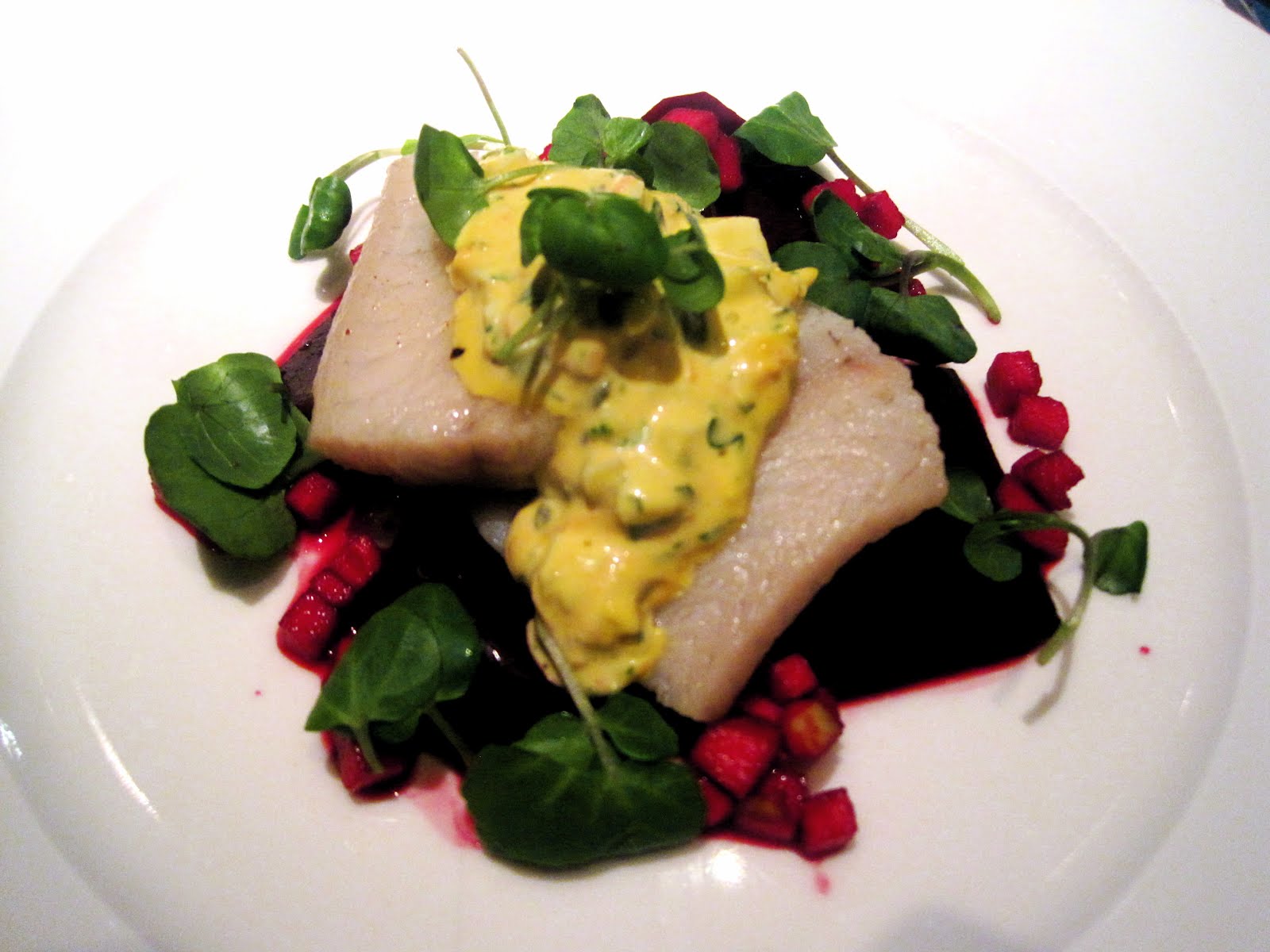
A second starter of smoked eel with balsamic beetroot and egg and wasabi mayonnaise is enchanting. The pearl pink slices of meaty eel rest atop a bed of beetroot and watercress, the smoky taste of the fish lifted by refreshing cubes of apple dyed red by the beetroot ink, while the mustard-yellow wasabi mayo delivers a life-affirming kick of heat. After a trio of standout dishes, my final starter of tagliatelle, purple sprouting broccoli, capocollo and mozarella fails to reach such heights.

Though painterly in appearance, the pink ham and grass green broccoli jumping out against the sunshine yellow pasta, the consistency of the sauce is disappointingly watery, while the melted mozzarella chunks are bland and soggy. For a Michelin-starred restaurant, the dish doesn’t have the X-factor, lacking the intrigue and finesse I’d expect. Lionel however, delights, pitting 2009 Ernst Triebaumer Blaufrankisch from Austria against 2009 Black Cottage Central Otago Pinot Noir. The former is floral, feminine and perfumed, while the latter bursts with black cherry and red berries, offering a easy going, fruity mouthful.

To enliven our palates, we’re offered a pre-dessert in the form of a tiny triangle of ginger cake, enhanced by a dollop of crème fraiche and grated lime peel. Pudding proper is a satellite dish of crème brûlée. The creamy, vanilla-flecked interior is à point, though I find myself defeated after half. To pair, Lionel presents his final flourish, a glass of 2008 Muscat de Samos Grand Cru, served so cold it needed defrosting. Had the bottle been left out in the snow?

Being a Chiswick local, I wanted to like La Trompette more than I did. I wanted to blow its trumpet. It has all the hallmarks of a superb neighbourhood restaurant – service is attentive yet unobtrusive, the atmosphere is animated, the interiors tasteful, and yet for me there was something missing. That all-important sparkle that separates a good restaurant from a great one. La Trompette displays flashes of brilliance, but it failed to keep my fire lit.

La Trompette, 5-7 Devonshire Road, Chiswick, London W4 2EU; Tel: +44 (0)20 8747 1836; £42.50 for three courses.

Sunday, 15 January 2012

Invivo dinner at The Fulham Wine Rooms

Proving that small can indeed be beautiful are Rob Cameron and Tim Lightbourne of Invivo Wines, a boutique New Zealand winery founded by the entrepreneurial pair in 2007. Making wine from both Marlborough and Central Otago, Invivo released its first wine in 2008 and has built up its range to five wines: a Sauvignon Blanc, Pinot Noir, Pinot Gris, Rosé and a low alcohol Sauvignon Blanc called Bella, known as "skinny Sav", which is proving incredibly popular with health-conscious women, leading the boys to triple production.

While in town last month, winemaker Rob Cameron (left) showed off his quintet at The Fulham Wine Rooms at a dinner organised by Jimmy Smith of the West London Wine School. Having worked stints in Slovenia, Cyrpus and Moldova, Cameron is happy to be back in his homeland, with business partner Lightbourne – who counts L'Oreal among his previous employers – looking after the marketing.

Conscious of the importance a label can have on a global brand, the pair struck upon a dynamic design; a white eight-point star set against a black background created by New Zealand fashion house Zambesi. But with so many wineries out there, what makes Invivo different? “Hands on marketing, hands on winemaking and a strong belief in the quality of our wine,” enthuses Lightbourne. “We don’t just send a container of product to our export market, we send ourselves as well."

Ensconced in The Fulham Wine Rooms' private dining room, Cameron kicked off with 2011 Bella Sauvignon Blanc, which I was curious to try. The nose displayed all the typical Kiwi Sauvignon aromas you'd expect, from blackcurrant leaf to freshly cut grass, pineapple and passion fruit, while the palate offered mouth-watering acidity and surprising body and punch for a 9% abv wine. Having been charmed by Bella, we moved on to the 2011 Pinot Gris produced in Marlborough. The feminine nose showed exotic aromas of quince, fig, lychee and poached pear, while the unctuous palate offered both texture and clean acidity. To match, we enjoyed an autumnal tartine of aubergine and mushrooms in an earthy, creamy sauce.

For the main event, we moved on to the estate's signature wine, the 2011 Marlborough Sauvignon Blanc, releasing the inner philosopher in Cameron: "With our Sauvignon Blanc, it's about creating a moment in time in the vineyard." More fragrant than Bella, it had a zingy nose of cut grass, tropical fruit and freshly squeezed lime. Bright and alive, the palate was deceptively powerful, with impressive concentration and lift from the vibrant acidity and herbal notes, which proved a great pairing for the accompanying fillet of cod in a zesty sauce vierge – a virgin sauce made from olive oil, lemon juice and chopped tomato.

Up next was 2010 Sophie's Rosé, named after the founder of Zambesi. A pretty salmon pink, the fresh, summery wine burst with strawberries, raspberries, redcurrants and watermelon. A charming picnic wine, it proved a perfect pair for our pineapple pud. Saving the best till last, Cameron cracked open his 2009 Central Otago Pinot Noir to enjoy with the cheese. By far my favourite wine of the night, its deep ruby colour revealed a meaty nose of forest floor, red berry, smoky bacon and herbal aromas, while the soft, perfumed palate of bright red cherries almost longingly recalled a beautiful Burgundy. Was he aiming for a Burgundian style? "All New World winemakers that make Pinot Noir are aspiring to the heights of great Burgundy," Cameron admits.

Wine aside, both Cameron and Lightbourne take a great interest in art, sponsoring and setting up an Invivo bar at the 2011 Venice Biennale, and nurturing homegrown creative talent, including musicians, fashion designers and their latest discovery; a group of graffiti artists, TMD Crew, at the forefront of the global graffiti scene. Could this mean a daring new label for Invivo's next release? Watch this space...