Friday, 12 October 2012

World's most expensive cocktail


Yesterday I was invited to The Playboy Club in Mayfair to witness maestro bartender Salvatore Calabrese attempt to break the world record for the world's most expensive cocktail, held by The Skyview Bar at the Burj Al Arab Hotel in Dubai, with a £3,766.52 tipple. In front of a Guinness World Records adjudicator and a raucous audience of London’s top bartenders, Calabrese revealed the four elements that would make up his Salvatore's Legacy cocktail.
Made up of 40ml of 1788 Clos de Griffier Vieux Cognac, bottled around the time of the American Revolution, along with 20ml of 1770 Kummel Liqueur – the year Captain Cook claimed of Australia, 20ml of 1860 Dubb Orange Curacao and two dashes of Angostura Bitters from the 1900s, Calabrese priced the liquid history at £5,500 a glass. All he needed to break the world record was a buyer.

Silence fell upon the packed room as he was presented with the first bottle – 1788 Clos de Griffier Vieux Cognac, which took Calabrese over five minutes to prize open with a combination of a knife, corkscrew and metal tongs. The following three bottles proved easier to enter, with Calabrese using his first ever shaker to mix the spirits in, pouring the result into a vintage cocktail glass. Fortunately for Calabrese, the cocktail was bought by a long-term client.

Click on the video below to watch Salvatore in action


The record comes just three months after Calabrese was left “heartbroken” when a treasured bottle of 1788 Clos de Griffier Cognac worth £50,000 was smashed by a customer at Calabrese’s bar at The Playboy Club. The bottle, which was destined for the record attempt, fell off the table when the customer asked to look at the label, having ordered two glasses at £5,050 each. 

“I was devastated when the bottle smashed and thought my dream of breaking the world record was over, but it has all worked out,” a jubilant Calabrese told me after smashing the world record. I was lucky enough to try a drop left over in the shaker and was astounded by its freshness and vivacity. It tasted like Vermouth, with herbal hints, spicy notes and a bitter edge. There’s life in the old bottles yet.

Thursday, 11 October 2012

South Africa: time to talk terroir


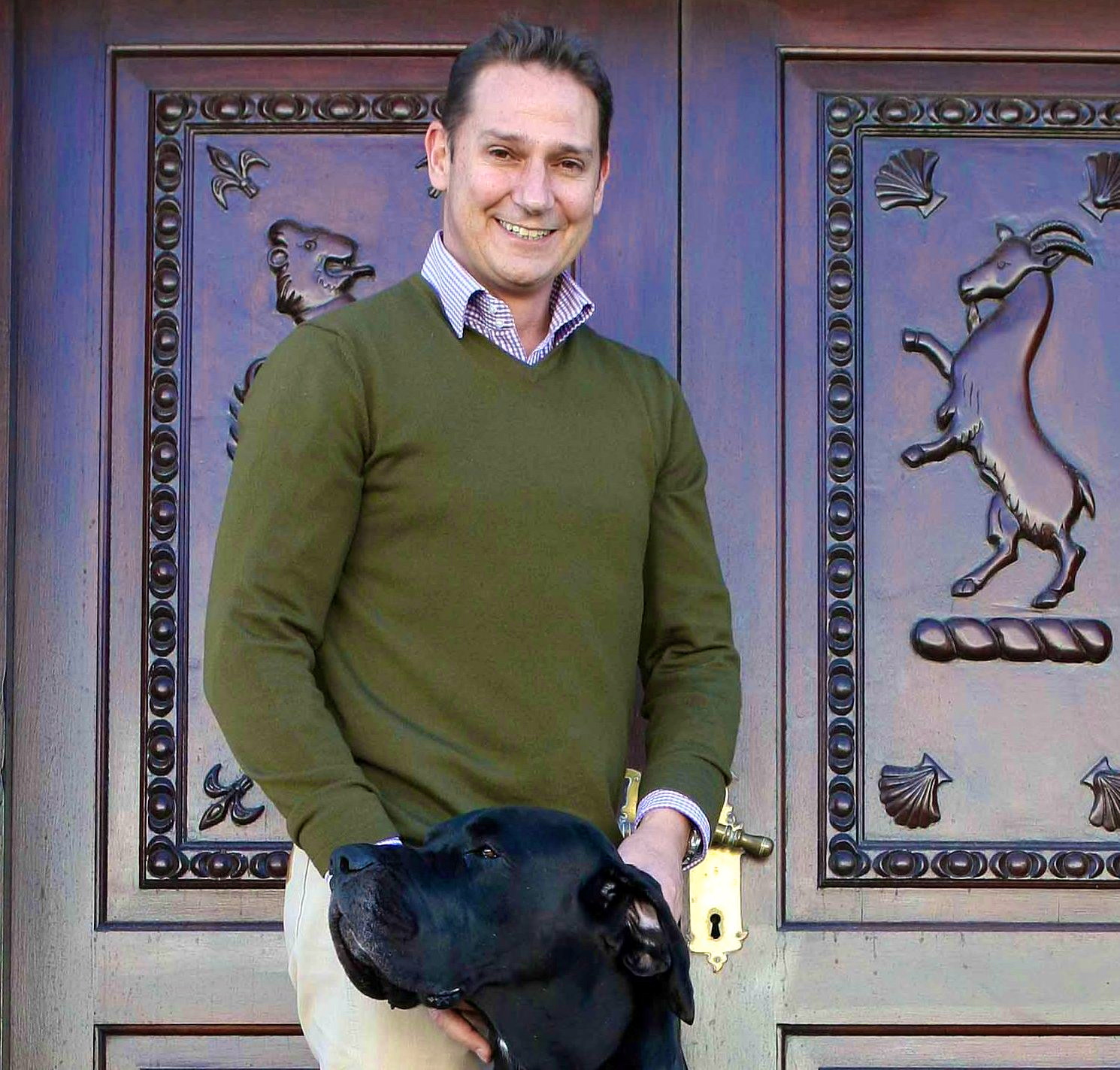
Terroir needs to be at the top of South Africa’s agenda according to one of the country’s leading Pinot Noir producers, Anthony Hamilton Russell, owner of Hamilton Russell Vineyards in Walker Bay. “South Africa needs to sort out its terroir message in order for it to be taken seriously as a fine wine producing country. It will help us promote our fine wine offering. The importance of terroir very much exists in South Africa, it just hasn’t been communicated properly yet,” Hamilton Russell told the drinks business at Cape Wine last month.

“Terroir is fundamental to the Pinots I produce. The stony, clay-rich soil in Hemel-en-Aarde helps us to get closer in style to Burgundy than any other New World country,” he said, admitting that it has been “tough” being a South African fine wine producer and trying to convince the world of the worth of the country’s top wines: “I’m proud everyone has persevered. If we were American our wines would be on allocation."

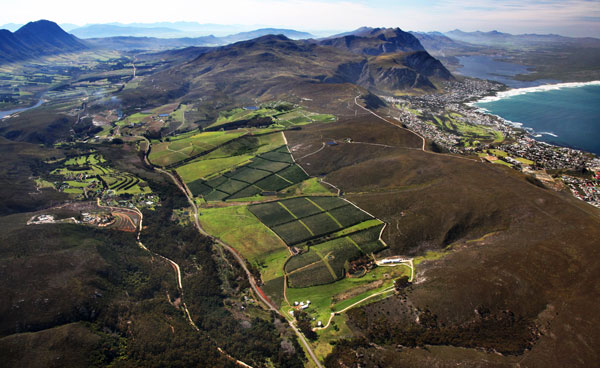
South Africa's premiere Pinot Noir region, Hemel-en-Aarde
Paul Cluver, managing director of Elgin-based Paul Cluver Wines, agrees that South Africa’s top end wines offer “outstanding” value. “You’d never find the same quality/price ratio in France or the US. We’re just suffering from a bit of an image problem. People are not willing to pay more than around £20 for South African wine at the moment. We need to shift our focus to our premium offering and market ourselves better,” Cluver said.

Hamilton Russell’s Walker Bay neighbour Peter Finlayson, owner of top Pinot producer Bouchard Finlayson, agrees that South can get closest to Burgundy in terms of tannin content. Our best Pinots are well structured, with good tannins and good extraction. There are no vacumes in the wine business. I’m seeing a lot of newcomers to Pinot Noir trying to capitalise on the favourable returns it affords,” he said.

Finlayson believes the challenge for South Africa moving forward is to look at terroir specification. “We need to streamline our efforts and focus on making wines with a sense of place. I’d like to see the terroir approach really take hold across the Cape. I’m starting to see it happen,” he said. Thys Lombard, sales and marketing manager of Tokara meanwhile, believes the key to success in the fine wine sphere lies in pricing the wines down slightly, so they remain exceptional value.

“South African fine wines are starting to enter the market at the price they are supposed to be. We got complacent, but we’ve lost our arrogance and become critical of ourselves, which is healthy. We’ve gone back to the drawing board. It’s a good thing that our best wines are not priced too highly. We’re aiming for the top of course, but I’m happy for us to be thriving in the middle at the moment.”

Wine writer Michael Fridjhon agrees that rather than trying to dominate the top tier, South African can carve out a niche at £10-£20. “I’m not sure the future of South African fine wine lies with icon wines. The £10-20 bracket is where we should be ploughing our furrows."

Wednesday, 10 October 2012

The Ledbury crowned UK’s best restaurant, again...


Two Michelin-starred Notting Hill restaurant The Ledbury has been crowned the best restaurant in the UK at the National Restaurant Awards for the third year running. As reported on db.com, the restaurant, run by Australian chef Brett Graham, saw off competition from Jason Atherton’s Pollen Street Social and Marlow pub The Hand and Flowers, which came in second and third respectively.

Owned and run by Tom Kerridge, The Hand and Flowers, the world’s first pub to be awarded two Michelin stars, was also named Gastropub of the Year. Five of the top ten restaurants on this year’s list are in London, with Quo Vadis in Soho, run by Jeremy Lee, the highest new entry at number 9. Master sommelier Xavier Rousset’s Texture in Marylebone bagged the Wine List of the Year award, while Lima London in Fitzrovia was voted the One to Watch.

Phil Howard meanwhile, of two Michelin-starred The Square in Mayfair, was voted Chef’s Chef, while Dinner by Heston Blumenthal picked up the Hotel Restaurant of the Year award. Chris Corbin and Jeremy King, owners of celebrity favourites The Wolseley and The Delaunay, along with the newly opened Brasserie Zedel, scooped the Personality of the Year award.

Earlier this year, the Ledbury climbed 20 places to number 14 at The World’s 50 Best Restaurant Awards, making it the highest climber on the list. And if running the UK’s best restaurant wasn’t enough, Graham and his team heroically protected diners last August when the restaurant was attacked during the London riots, chasing away masked looters with rolling pins.

Now in their fifth year, the National Restaurant Awards aim to highlight the best restaurants in the UK and reward the nation’s top chefs and restaurateurs. The restaurants are voted for by a team of 150 chefs, restaurateurs, food critics and journalists across 12 UK regions. Chefs are not allowed to vote for their own restaurant. 

The Top 10 Restaurants in the UK

1: The Ledbury, London

2: Pollen Street Social, London

3: The Hand & Flowers, Marlow

4: Restaurant Sat Bains, Nottingham

5: The Fat Duck, Bray

6: The Sportsman, Seasalter

7: The Square, London

8: The Kitchen, Edinburgh

9: Quo Vadis, London

10: Dinner by Heston Blumenthal, London 

Tuesday, 9 October 2012

Koch’s Jefferson lawsuit thrown out of court


Bad news this week for billionaire wine collector William Koch, who has lost his bid to reinstate a lawsuit against Christie’s that claimed the auction house “induced” him to buy counterfeit wine. As reported on db.com, the US Court of Appeals in Manhattan last week upheld a 2011 ruling by US district judge Barbara Jones dismissing Koch’s suit after finding that he waited too long to sue, agreeing that the statute of limitations had expired.
“For wine, timing is critical, the same is true for causes of action,” said US district judge John Koeltl, who was sitting on the appeals court for the case. “I’m very disappointed by the decision. The appeals judges dismissed the case for a technicality, although we know they got a lot of the facts wrong, but they’re the ones who decide what the facts are,” Koch said. “Christie’s got away with an incredible hoax,” Brad Goldstein, a Koch spokesman, told Bloomberg. Koch filed a lawsuit against Christie’s in Manhattan in 2010, claiming the London-based auction house had sold him counterfeit wine “for many years.”
Koch also said that Christie’s had “induced” him to buy four bottles of 1787 Château Lafite engraved “Th.J” that had purportedly belonged to American President Thomas Jefferson from German wine dealer Hardy Rodenstock in 1987 because Christie’s described the wines “positively” in auction catalogs during the 1980s. The wines were allegedly discovered in the mid-‘80s when Rodenstock claimed to have found a cache in a bricked-up cellar in Paris. Koch had the bottles tested in October 2000.
One of the purportedly fake Jefferson bottles
In dismissing the case last year, Jones said Koch knew the bottles were counterfeit and that he bought the wine out of a “desire to gather evidence against Christie’s.” Jonathan Lerner, a lawyer for Christie’s, told Bloomberg: “Today’s court ruling was clearly correct, Koch’s claims turned to vinegar a long time ago. The only hoax in this case was the allegation in the complaint that ‘no credible question’ had been raised about the wine until shortly before the complaint was filed.”
Koch should have made inquiries about the wine by October 2000, when a report was issued about its authenticity, the appeals court said. He filed his suit in 2010. A historian at Monticello, Jefferson’s former home in Virginia, issued a report in December 1985 that determined “no solid connecting evidence could be found between Jefferson and the Th.J wine.” While the report didn’t become public at the time, newspapers including the New York Times published articles saying there was “scholarly doubt” about the authenticity of the wine. Koch has previously sued Rodenstock and American auction houses Zachy’s and Acker Merrall & Condit for fraud.